Saturday, November 9, 2013

Lauca park

This has sort of been the highlight of my trip throughout northern Chile, and a tremendous way to close this chapter of Chile. It was a needed trade of hostals and mining towns, to pitching up my tent and enjoy the huge, Swizz-like mountains! The Lauca Park is situated in the Andes between Chlie and Bolivia at 3,500 to +5,000 masl, with snow covered volcanos reaching +6,000mbsl! Very impressive! I spent a few days in Putre dealing with high alltitude sickness and enjoying the spectacular surrounding, and later camped out at Chungara Lake (at 4,500masl), before heading over to Bolivia.


Putre (at 3,500masl) is the main village in the park, and although very small, will provide you with everything from lodging and food, to petrol (ask around, it is sold in houses and hostels). As Putre was revealed to me when I came over the last climb, I stopped mindblowned! Even though I have never been to Switzerland, the view was like taken out of a post card!! I also very much appreciated the warmth and openess of the locals, and took delight in watching them herd their animals to and from their breeding ground at dusk and dawn.


As I drove into town, I easily found the main square, and the tourism office. He gladly answered my questions, gave me maps, and recommendations. I was able to set up my tent on the soccer field just toward the end of town, and when set up, I headed back to enjoy a warm cazuela (Chilean soup and dinner). I heared romours about a party that night, and upon asking, was given directions. Later on that night, as I followed the sound of dance music through the town, I eventually found the place of the gran party. Not very impressed with the almost high-school-dance sort atmosphere, I ended up drinking some beers with a group of road construction workers. As the night went on, more people joined the party, and it turned out quite well!


Having my cup of coca-tea
The next morning I was stuck in my tent with a terrible headache until early afternoon, with what I did not know at the time was not a hangover, but high altitude sickness (probably a good mix of both)! "Acquired at high altitude or in low air pressure, resembling a case of flue, carbon monoxide poisoning, or a hangover" - Wiki. The recommended "cure" is to drink plenty of liquid (surely beer does not go into this category), and especially the coca-leaf tea. - Although an attempt was made to break camp and see more of the park, I remained in Putre that day!

A German couple I stumbled upon
The day after, I was determined to set out early, to enjoy the ride toward Chungara Lake. I made a few stops to appreciate the unique wild life that exist at this alltitude. The "caves" did not prove very impressive, though it was a great spot to shoot some rabbits and vicuñas (photos ofc!). I also had to stop to marvel at the wild llamas grazing at the side of the road. Also, the road windes through some stellar landscapes and rock formations, but at times like that, it is just a treat not having to stop to take photos, but to fully enjoy the magnificence.


The very unique rabbit
Black bird in the sky

Vicuño


Finally arriving at Chungara Lake, I parked my bike and took a walk to see the stunning view of snow covered volcanos and mountain tops around the lake, and a range of exotic birds and fauna just on the water line. As the sun was starting to decline, I was offered a spot at the vacant camping (with a spectaular view of the lake), but (almost) most importantly, the park guardians let me cook some food in their cabin!! (After my previous failed attempt to use my cooker...) Along with the fresh supply of mountain water, my delisous pasta dish with tomato sauce and sausages, and the not to shabby view point of the lake, I was pretty content!


Lake Chungara

Llama llama llama llamallamallamama

The line-up to cross over to Bolivia

Now that is before the sut really was setting, at the temperature was dropping too rapidly. At 4,500masl, Lake Chungara is the highest in the world, and it gets to about -10C at night, sometimes with heavy gusts. I managed okay with my thick MEC sleeping bag, but I suffered an intense hangover headache from the cold night and the high alltidude, thus was not leaving the tent until midday next day, after taking some headache pills. : / Very funny, with my tent open for ventilation, I noticed some curious faces looking in from the other side of the meter tall stone wall encircling my camping spot. I later noticed it was the children from the vendor working at this touristic spot. - They must have really wondered what was wrong with this strange person!!

I was feeling fine by early afternoon, and after a cooked delicious lunch (from the day before), a some really dark clouds were approaching and I set off to the Bolivian border in a hurry! On my bike, I past the Km:s long line-up of trailers. I felt very little among these huge trailers as I cruised around the border to get the paper work done! - Everything went well!

Although I have been previously exposed to high altitudes, ...in San Pedro, and told to drink the coca-leaf-té and take extra precautions to acclimatize better, as usual I thought of myself as a superman! Still, the amazing scenery has made me confident that I will come back again, despite the alltitude!


Saturday, November 2, 2013

Crossing the border from Chile to Bolivia


I know some of you have had problems crossing the borders between Chile, Peru, and Bolivia. 

I crossed the border from Chile to Bolivia at National Park of Lauca, along with ALL the trucks and trailers coming and going from the harbour in Arica. But with my bike, I passed the km:s long line-up, and looked up what had to be done before being cleared to exit Chile.

I only had to show proof or purchase and registration of the motorbike (in my case since I am the only owner), an International Insurance, and fill in some paper work. 

Later I proceeded toward the Bolivian border, and after making some photo-copies, getting some stamps on a piece of paper, I was set to enter Bolivia. However, which I came to learn when leaving the country. I was never given a "Permission to Circulate" (Permiso de Circulación) nor was the bike actually registered in Bolivia. Be sure to have this in your hand as you leave the border control!!

 Bolivia is such a beautiful country to ride a motorbike! Good luck to all of you crossing the border! ^^

Pic fr www.carlosdmesa.com

Arica - The most northern city in Chile


Arica has mostly been a place for practical matters, although there has been a few other highlights. Arica is the most northern city of Chile, with a large port and a close connection to both Peru and Bolivia. I found myself doing the 2nd service of the bike here, and enjoyed a few slow and relaxing days before going up into the mountains and onward to Bolivia.


In the northern part of Chile, Cazuela (traditional Chilean food),  is very commonly served as lunch and dinner. In Arica, you pay not more than C$ 2,500 (US$ 5) for a soup with meat, potato, and some veggies (La Cazuela), bread, and a full main dish of your choice. I was amazed to eat home cooked food for such a cheap penny, and happy of the change from empanadas and other fast foods. And there are lots of places serving La Cazuela, (a.k.a. "El Menú por favor!" as you would order it). 

I bought my "International Insurance" with Magallanes Seguros, a document that is required to cross the border with a Chilean vehicle (along with other important documents, depending on whether you bought a used or a new bike). This did not take me more than 10 min from stepping into the office, to walk out with my International Insurance from Magallanes Seguros in hand.

Arica was actually part of Bolivia before the War of the Pacific between Chile on one side and Peru and Bolivia on the other. Along with a history museum, you will find a marine museum. I recommend visiting the tourist office, from which I left with all the information I could ever ask for, for my trip to Lauca, also Arica, and all the other places worth visiting in Chile. It is located on the main square, along with the old church (pic below). 


Although there is a long beach, a supposedly good night life and a number of museums, I mainly enjoyed the great food, accommodation with internet and some rest, while preparing for the trip to Lauca park, and then Bolivia! 


High altitudes - You and your bike

There has for sure been an eye-opening experience to deal with the higher altitudes along the Andes. I was at first not aware of the effects of ascending or staying at high altitudes, neither on my bike nor on myself. I have therefore come to learn (through experience) more than I have cared to learn. :)  

Altitude sickness:
At higher altitudes (+2,500 masl), although the 21% of oxygen in the air remains the same, the air density decreases. This means that the lungs absorb less oxygen than it would normally, which makes any physical activities harder to perform. (Ex. Walking up a set of stairs). Aside from this, further side effects may include head aches and stomach pain, which may show up to 12 hours after the actascent. However, higher altitudes may for some people not be a problem at all, and for others (like myself) be a pain in the @ss. 


Enjoying a cup of coca-leaf-té in the morning sun at Lauca
It was in San Pedro when we went to see the Geysers (at 4,500 masl) that I first started to appreciate the effects of high altitude. Just walking briskly had me catch my breath. We had prepared some hot water with coca-leaves before we left, which is suppose to help against head aches and stomach pain (you can even chew on the leaves). - When I later went to Lauca National Park at 3,000 to 5,000 masl and stayed for a few days, I got really bad, piercing head aches (which I first thought was the effect from the first night´s party). But some head ache pills helped to alleviate the pain a bit.

It is important to drink plenty of fluids, even start a few days before the ascent. Furthermore, it will help to ascend slowly, spend a day or so at lower heights (2,500 - 3,000 masl) before continuing. Also, if needed you can descend a bit if the symptoms become to intense. Keep in mind to maintain a low pace, take it slow, walking as well as just moving around. 

Have a read at wikipedia:


Riding a bike at high altitudes:
As I approached San Pedro (at 2,500 masl) earlier on my trip, my motorbike started to ride both slower and weaker. Without much thought to the matter, but rather focused to arrive at my destination before sunset, I turned up the accelerator. In this manner did I not only use up way above avg gasoline / km, but also (according to my Honda mechanics at 2nd service) busted a vale in the engine. :S ..ops!  

Like us humans, the higher altitudes makes it harder for the engine to perform physical labour. The carburetor, which is responsible for the air and gasoline mix that enters the engine, will mix air with less density then normal, hence with less oxygen and relatively too much gasoline, the engine will lose power output. Now being aware of this, I don´t turn the accelerator to maximum believing that it will generate maximum power, but notice instead when I force too much gasoline into the engine, and release the accelerator to arrive at a optimal balance and power output.  

I came across a video that explains very well how a carburetor works and what it actually does.


It can be a good point to ask the service mechanics about this, if you are heading up into the mountains. And if you have not been at high altitudes before, remember to ascend at a cautions rate, especially if you intend to stay at this altitude for some time. - Good luck and let me know if the post is useful!! 
(Comment box below) 


Wednesday, October 30, 2013

The Salt Lakes - San Pedro The Atacama

Enough with the bicycle, and back on the motorbike! (and on this trip to the salt lakes I think it was a good idea!) The first lakes are only five km away from San Pedro, but the other lakes lie farther away and are definitely worth the visit. As the desert sun can be a little overwhelming during midday, early morning or the afternoon are recommended hours to set out on this exploration, especially with regular bicycles. 

The dogs accomanied a couple riding bicycles from town
The salt lakes are situated more toward the middle of the huge salt flats, and render a grand panoramic view of the vast barren landscape with the impressive mountain ranges at the line of the horizon. The salt has been accumulated from the time when the area was at the bottom of an ocean with a particularly high concentration of salt. The lakes now form part of a very unique ecosystem that you  find at these high altitudes (>2,400 meters above sea level), with a certain type of flora and fauna that thrives in this salty climate. 


I really enjoy taking some trips with just my bike and no luggage to fully enjoy the terrain and the landscape. - My first stop was the three first lakes, ... or ponds. I was really struck by the strong and bright colors of the grass, the water, and the sky. After some shots of the lakes and its surrounding, it was time to try the high salt level! - And sure enough, there was definitely no need for a floating device as you could lift your limbs out of the water! Incredible! The cool water also offered a needed break from the intense sun. 


I met a couple that had rented bicycles from town, and felt a bit sorry for them as I left them behind heading to the next stop. The cool breeze from riding the bike was for sure something that they could not enjoy. After a good cruise through the white barren desert, I found myself between two round basins, in the middle of nowhere. The two "Eyes" appear as though they would be unnatural, or does not seem to fit as they are about the same size, right next to each other, with no similar phenomena in sight. - It is an amazing sight! 


The two Eyes

The last stop on my day trip, and maybe the most awe-striking, was a lake with solid salt "rocks" on the surface, and a magnificent view of the mountains in the background. After having spent quite some time in the sun, I sat myself in the shade of the bike (which immediately gave a refreshing and needed break from it), to just enjoy the breathtaking view. After awhile, some snacks, and good number of photos shot, I decided to head back to San Pedro. 


When I past the eyes I encountered the couple again, who decided to turn back at this point too, but with a good stretch in front of them before arriving to San Pedro again. If I had a rope or something, I´d give them a ride part of the way for sure!


Add caption


Advice from a truckdriver - Useful equipment to carry with you

On the road from Santiago to La Serena, after my embarrassing accident (my bike fell over when I was parking) a truck-driver stopped to help me out with minor repairs. With his +30 years of experience, he shared a few insights I had put in the back of my mind.

Always carry tools to repair a flat tire:
On my bike, it works very similar as to a normal bicycle. Therefore, I carry, two metal "rods" to displace the tire, patches to cover the hole of the tube, and glue to make it stick. Also, as a regular bicycle hand-pump wont do, I bought a "can" that will temporary that will inflate the tire sufficiently to get to the closest gas station. 

Moreover,
Plastic cable ties, whether it´d be a screw and bolt gone missing, or to to secure a piece of equipment, ...like duck-tape, it always comes in handy!

Lubricant Oil for the chain, I´ve been recommended to use it every 200-500 km for good maintenance of the chain. In a normal store, a guy gave me a W40 to use for cleaning and free up rustic pieces, but it does not work for lubricating the chain (Hence, go to a garage or dealer with your questions if you are unsure).

Use a rope to secure your luggage

I mainly used the common stretchable ropes with hooks at the ends to tie down my things on the bike. I was taught that they will eventually start to lose tension, hence allowing your luggage to shift when you drive, and in worst case scenario make you fall over at high speed. The wise truck-driver recommended me to mainly use a normal rope to secure your bags, and use the stretchable ropes and nets to compliment afterwards.


If you are unfamiliar to securing with ropes, there are several youtube videos showcasing the basics!  http://www.youtube.com/watch?v=w9YVoZMndbc

  • Always secure your luggage with more than one piece / kind of rope, in case the first fails.
  • Keep in mind to pack your things as low as possible to avoid a high point of equilibrium. (See the impeccable example above) :)


Wednesday, October 23, 2013

The Geysers - San Pedro de Atacama

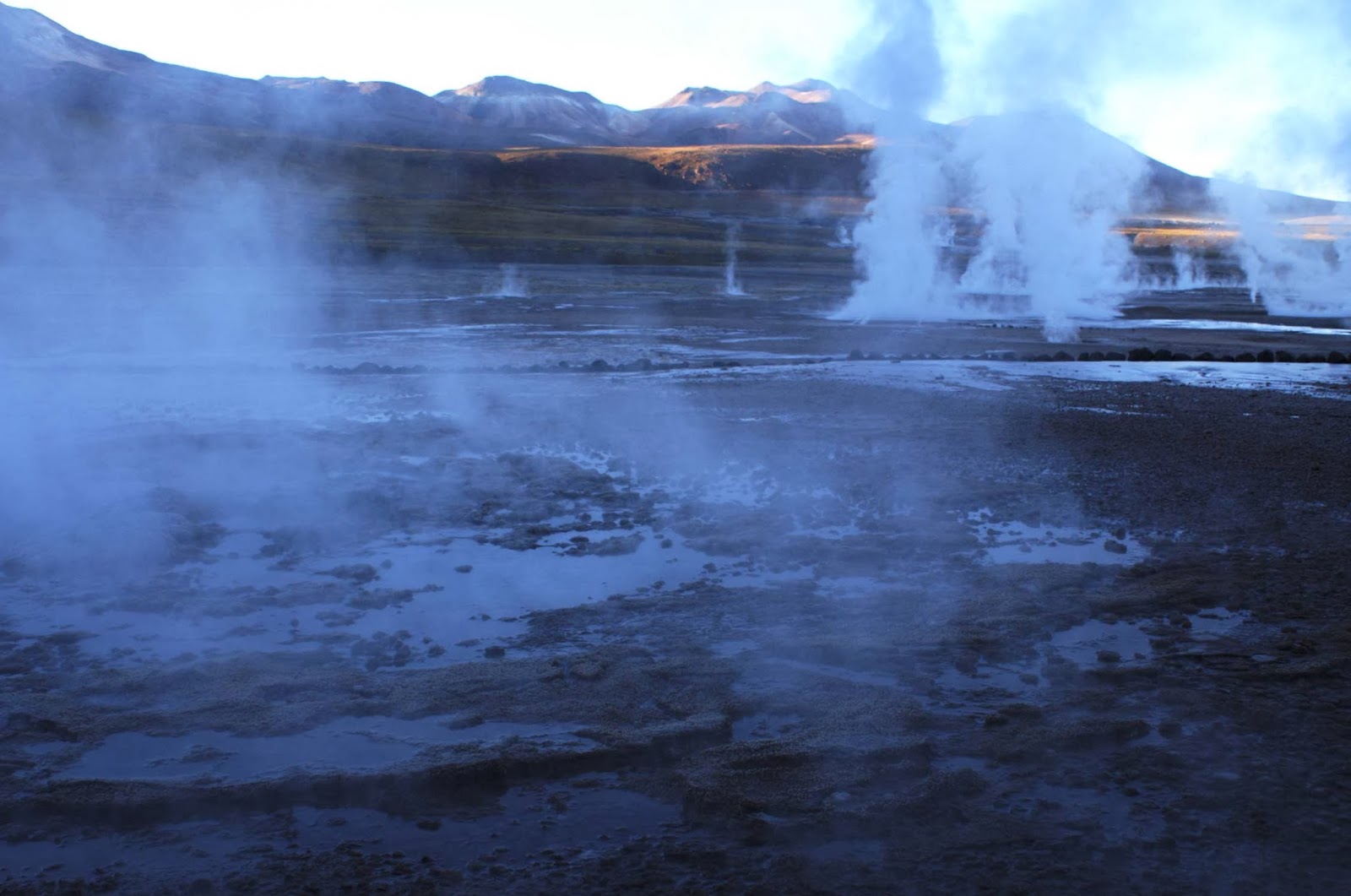
The Geysers is a spectacular phenomena which you can only behold in the early morning high up in the mountains. It is an all together amazing experience, being up before sunrise, in a beautiful basin high up in the mountains, watching the geysers pour out the ground, and with a refreshing morning temperature of -9C (not kidding!) The tour is well worth the money, and we locked out with a great guide!

Our hostess had already prepared hot water with Coca-leaves for the high altitude when we awoke some minutes before 4 AM. A little drowsy still, we huddled up the best we could in the bus to enjoy the hour and a half of sleep as we climbed to an altitude of ~4500 m (San Pedro is at ~2200m). When the sun started to illuminate the basin we were finally arriving at El Tatio. We could already see the geysers in the distance, with a height up to 10 m and a temperature around 85C (just perfect for a Uruguayan "Mate", as someone pointed out!)


Pictures say more than a thousand words...


And then, the sun finally rose above the crest, and the temperature instantly started rise from negative to a comfortable positive in a few minutes. Just in time for some hot coffee and a sandwich that the tour had prepared for us. - A truly unforgettable breakfast!! 

When the geysers started to diminish and we were all fed and a bit warmer, we headed over to a natural hot spring for those who wanted to take a morning swim. - Naturally, there was no doubt that this had to be done!  
(Photo evidence will be uploaded asap!)


My beautiful companions, Carola & Luisa


I was awestruck by the amazing flora and fauna we witnessed on the way back. Such bright and clear colors of blue and yellow. The Vicuñas roaming freely in this remote landscape high up in the mountains, a fox stopped by the side of the road, and we saw some flamingos settled in a pound beside the road. In the distance we could see the vast salt flats, and on the horizon the numerous volcanoes in the area.   


Flamingos! 


Also, the land was navigated by the Inkas during their era. The volcanoes were visited for spiritual rituals, and road marks were left behind to find the way. 


Although we found the Inkan way-mark, we were not in agreement about the way onward

Still we made it back at the hostel at around noon for a well deserved siesta! Sometimes it actually pays off rising up early in the morning! ...

The Moon Valley - San Pedro The Atacama

I´d never get myself into one of these!
The Moon Valley is as impressive geologically as it is stunningly beautiful. I rented a bike from the hostel (thought it would be good idea with some exercise) to check out the Moon on Earth. Although the park isn´t far away from San Pedro, nor that big, I spent a good six hours marvelling at the out-of-this-world rock formations, landscapes and natural history that is preserved in this unique place. It is strongly recommended to visit the park in the early morning or the afternoon (and stay for the sun set), because the sun is very strong.


Since my German room-mates were leaving for Uyuni in the early hours, I was ready to set off on my day´s adventure in the early morning. I carried with me a backpack with my 2 liter Camel-bag and food for the day ,and enthusiastically biked through the vast desert, saluting the road-construction workers along the way. After 20 min I reached the entrance / ticket office, where I enjoyed a very interesting and informative exhibition of the geological history of the area (in Spanish), and some shade from the ever present sun (for us Swedes, we don´t do well with desert heat / sun). (There was a group with a guide who was explaining everything in English!)

Strategic photo-seshion break
On the way up the first really steep hill, I noticed my fitness was way off the charts. I thought to myself, "Even if I haven´t been exercising actively for some time, this is ridiculous!" But before taking my photo sesh break, I guide passing my on her bike explained, "It is the high altitude!" as she continued onward ...

The name of the park was obviously adopted due to the resemblance of the moon´s surface, and sure enough, many of the things you see don´t seem to belong, but to another planet. 


The Moon


The Amphi Theatre: This formation was the result of thin layers of materials (sand, salt and clay) that were destroyed due to movements in earth´s crust. This formation normally occurs when a separation at lower levels makes the surface level drop in this manner. It is a spectacular sight!


The Amphi Theatre


A salty landscape

No, its not snow! ...its the moon!
The Three Maries: Only two remaining (someone "accidentally" pushed the third over) represent a formation of intense erosion processes that have shaped the rock into what it is today. These ladies have been around for an impressive one million years.

Me and the Maries


"Onix, I choose you!"

..and the Great Sand Dune

The Great Sand Dune! The sand has accumulated for over thousands of years on top of what was once a natural barrier and now stands as the base for the dune. This is normally the end of the park, but you can also visit the salt mines..

.. which I naturally decided to do! Although there was no cave, I found the setting very fascinating, with a great view point of the grand white landscape! It sort of reminded me of an apocalyptic waste land, with little life and lot of... "waste land".

The entrance to the mine


a salty pond in the mine


An apocalyptic waste land (aka. The Salt Flats)


I noticed on my way back that more people were arriving in the afternoon. I had not been informed that the park offers an excellent spot for watching the sunset. Do keep in mind that you cannot enter the park after 6pm, so you need to get there earlier to enjoy the actual sunset much later. These are some shots from the way back:


I recommend to visit the park in the morning or in the afternoon, as the sun is very strong during midday. Also, do bring plenty of water and sun-block! If you are interested in the geological explanations of the formation of the sights, I´d recommend taking a tour, private guide, or a friend that can translate the information available in the exhibit!


- Enjoy!!